

What if your curl pattern is only one part of what makes a haircut work? If you’ve worried that a stylist might cut your curls without considering how they naturally sit, move, and change from day to day, you’re not alone. Learning how to find a curly hair stylist starts with looking for a thoughtful, personalized approach, not a one-size-fits-all answer based on curl type alone.
Your hair’s density, strand thickness, condition, color or chemical history, routine, and desired shape all help guide a cut. A meaningful consultation gives you room to share that context, explain what you’d like to change, and talk through how much styling your lifestyle allows. Clear communication can make the appointment feel more collaborative and help your stylist shape a result that feels like you.
At Tanya’s Image & Wellness Salon in Hyde Park Square, Cincinnati, consultations consider your hair, lifestyle, and goals. This guide will help you recognize signs of attentive curl expertise, prepare for a curly haircut, and understand how dry curl cutting and styling education can support your natural texture.
Key Takeaways
- When considering how to find a curly hair stylist, look beyond curl pattern to how a stylist listens, assesses your hair, and understands the shape you want.
- Notice how hair density, strand thickness, condition, and past color or chemical services may shape the haircut conversation.
- Before your appointment, jot down your current routine, maintenance preferences, relevant hair history, and the result you hope to achieve.
- Learn how dry curl cutting and shaping can work with curls in their natural state, and how styling guidance can support your routine between visits.
- Explore a personalized curly hair approach at Tanya’s Image & Wellness Salon in Hyde Park Square, Cincinnati.
How to Find a Curly Hair Stylist: Start With More Than Curl Type
Finding someone who understands natural texture can take more than matching your curl pattern to a photo or chart. You may have had a cut that looked appealing at first but didn’t account for how your curls settle, or found it hard to explain what you want without knowing the right terminology. A more useful starting point is noticing how a stylist listens and whether their questions make room for the details of your hair and your daily routine.
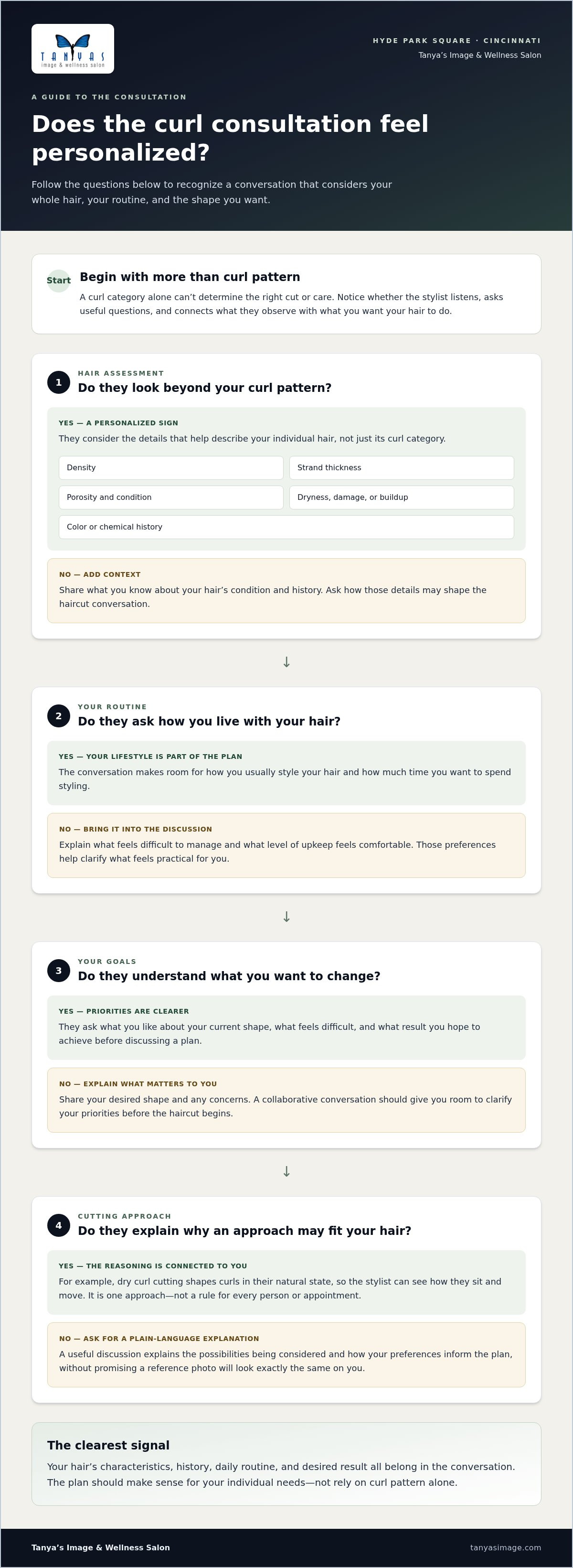
A curl-focused stylist assesses your hair and your goals together, rather than treating curl pattern as a complete guide to the cut. Look for relevant experience with textured hair, thoughtful questions, and clear explanations of how your preferences inform the approach. A stylist should be able to discuss possibilities in plain language, including what they’re considering and why, without promising that a reference photo will look exactly the same on you.
Pay attention to the conversation. Do they ask what you like about your current shape, what feels difficult to manage, and how much time you want to spend styling? Do they make space for your concerns and clarify your priorities before discussing a plan? These are practical signs of a personalized approach. Tanya’s Image & Wellness Salon offers hair services in Cincinnati, including curly haircuts shaped around individual hair and goals.
What does a curly hair specialist consider?
A thoughtful assessment goes beyond identifying waves, curls, or coils. It considers density, or how much hair you have; strand thickness; porosity, or how readily your hair takes in and releases moisture; and whether dryness or damage affects its condition. Color or chemical history, product buildup, lifestyle, and your desired result also help shape the conversation. For accessible background on the science of hair, readers can explore how hair structure and growth are described, while remembering that an individual consultation is about your own needs.
Two people with a similar curl pattern may have very different density, strand thickness, length, or styling habits. One may want a low-maintenance shape, while another prefers more definition or volume. Their hair histories and goals may differ, too. That’s why a curl category alone can’t determine the right cut or care; a useful discussion connects what the stylist observes with what you want your hair to do.
Why natural texture matters when assessing a haircut
Dry curl cutting means shaping curls in their natural state. Seeing how they sit and move can inform a discussion of the overall shape, where added length or layers might fit your preferences, and how your curls behave in their current condition. It’s one approach, not a rule for every person or every appointment.
As you consider how to find a curly hair stylist, listen for explanations that connect the cutting approach to your hair rather than presenting one method as universally best. A clear, collaborative conversation helps you understand the plan and share what matters before the haircut begins.
What a Curly Hair Stylist Should Understand About Your Whole Hair
A whole-hair assessment looks at how your hair’s characteristics, current condition, history, and your personal priorities fit together. It isn’t a test you need to prepare for or a label you have to get right. The purpose is to give your stylist a fuller picture before discussing a haircut, shape, or styling guidance.
Curl pattern alone can’t describe an individual’s hair needs; the right conversation also considers its condition, history, and the way you want to wear it. This matters because two people with similar-looking curls may need different conversations. One may want to keep length while making styling easier; another may be seeking a different shape and have more time for daily styling. The assessment should help make those distinctions visible.
Hair characteristics that shape a personalized conversation
Density describes how much hair grows across the scalp, while strand thickness refers to the feel or width of individual hairs. Neither characteristic points to a single haircut. Instead, they help a stylist discuss how a shape may look and what you’d like to emphasize or simplify.
Porosity, dryness, damage, and product buildup offer additional context. For instance, if your hair feels dry or has buildup, it’s useful to share that rather than assume the concern is simply your curl type. A stylist can take those observations into account when talking through care and styling options, without treating every head of curls the same way.
Your history belongs in the discussion, too. Mention color services, chemical treatments, or changes in your hair’s condition that you’ve noticed. These details help your stylist understand what your hair has experienced and what you’re hoping to do next. You don’t need technical terms; a straightforward description of what you’ve tried and how your hair responds is useful.
Professional hairstyling involves more than a single technique. O*NET’s overview of the qualifications of a hairstylist describes the broader knowledge and skills associated with hair services. For curly hair, attentive communication helps connect that professional work to your specific texture and preferences.
Lifestyle and goals belong in the assessment
Your routine can shape what feels practical. Think about how you usually style your hair, whether you prefer a simple routine or enjoy taking more time, and what level of upkeep feels comfortable between appointments. These are not right-or-wrong preferences. They help frame a shape and styling discussion around your actual day, rather than an idealized routine you don’t plan to follow.
Be specific about the result you have in mind. You might describe wanting a shape that feels lighter, more movement, or a style that keeps its overall length. Photos can help communicate preferences, while your explanation of what you like in them gives the stylist important context. Ask for styling guidance that makes sense for your habits, not a routine borrowed from someone with different hair.
At Tanya’s Image & Wellness Salon, consultations consider hair, lifestyle, and goals together. If you’d like to explore a curl-focused conversation in Cincinnati, learn about curly hair services at the salon.
How to Recognize a Personalized Curly Hair Consultation
A thoughtful consultation should feel like a conversation, not a preset plan waiting to be applied. Your priorities deserve room in it: what you want to keep, what you’d like to change, and what feels realistic to maintain. At Tanya’s Image & Wellness Salon, initial consultations consider your hair, lifestyle, and goals, giving the discussion a personal starting point.
As you consider how to find a curly hair stylist, notice whether the conversation helps you explain your needs in your own words. You don’t need to arrive with technical terms or a perfect description. It’s helpful when a stylist listens, reflects back what they’ve heard, and clarifies details before discussing next steps. That exchange can make the plan easier to understand and give you a chance to voice questions or adjust your priorities.
What to share about your curls and routine
Before the appointment, consider what your hair is like on an ordinary day. How do you usually style it? Which parts of your routine feel manageable, and what would you prefer to spend less time doing? Sharing those details helps connect a haircut conversation to the way you actually wear your curls.
It’s also useful to describe what you enjoy about your current shape and what feels challenging. Maybe you like the length but want a different outline, or your curls feel harder to style around the face. Mention relevant color or chemical history, along with dryness, damage, or product buildup you’ve noticed. You can describe what you see and feel without diagnosing the cause.
Photos can clarify preferences, especially if you point out the feature you’re drawn to, such as the overall shape or amount of movement. They’re a reference for discussion, not a promise that another person’s hair will translate exactly to yours. Your own texture, history, and styling habits remain central to deciding what feels appropriate.
How a stylist can discuss shaping and education
A personalized conversation should make the approach understandable. Tanya’s Image uses dry curl cutting to shape curls in their natural state, and the consultation can include a discussion of how your curls sit and move as the shape is considered. The purpose is to connect the cutting approach with your hair and goals, not to suggest that one method is right for everyone.
Styling guidance can also help translate the appointment into everyday care. A useful exchange may clarify which parts of your current routine you want to keep, where you’d welcome direction, and how your preferred shape fits your maintenance habits. Curl education should support your understanding, not leave you feeling that you must follow a complicated routine.
For a closer look at the salon’s approach to textured care, explore curly hair services in Cincinnati. A consultation at Tanya’s Image can bring your hair, lifestyle, and goals into one focused conversation, helping you feel informed as you consider a curly haircut and care that fits your day-to-day life.
How to Prepare for a Curly Hair Appointment in Cincinnati
A little preparation can help you use your appointment time well, especially if it’s hard to turn a general idea like “more shape” into a clear request. You don’t need to know the technical language for a cut. A few notes about what matters to you can give the conversation a useful starting point and help your stylist understand what you hope to discuss.
Build a clear picture of your goals
Before your appointment, take a moment to outline what you’d like your hair to do. Focus on preferences rather than a promised outcome: perhaps you want to talk about a shape with more movement, keeping your length, or making your usual styling feel easier. If you have a reference photo, note what appeals to you about it, such as its outline or how the curls frame the face.
Next, jot down what works and what doesn’t in your current routine. Is your usual styling process manageable, or does a particular step feel difficult? How much time do you prefer to spend maintaining your hair? Your answers help frame the conversation around a shape and guidance that suit your habits, rather than an ideal routine you may not want to follow.
It can also help to make a short hair-history note. Include color or chemical services, changes in condition you’ve noticed, and concerns such as dryness, damage, or product buildup. Describe what you observe in everyday language. You don’t have to identify a cause or classify your curls precisely for the details to be useful.
Use the consultation to understand your next steps
During the appointment, share your notes and let the stylist know which priorities matter most. If several goals compete, such as keeping length while changing the shape, say so. A discussion of your hair condition and lifestyle can help clarify the options and what each might mean for the way you like to style your curls. You can also ask what styling guidance may help you understand and care for your shape between visits.
If dry curl cutting is part of the conversation, ask how shaping curls in their natural state informs the approach. A clear explanation can help you understand what the stylist is considering without assuming that one technique or result is right for everyone. It’s also reasonable to ask what the next steps involve and to pause if you’d like something explained in a different way.
As you plan a curly haircut in Cincinnati, exploring the salon’s hair services and appointment options can help you consider how your goals fit with its offerings. Preparing this way makes it easier to discuss the details that matter to you, while leaving room for the stylist’s assessment and recommendations.
Ready to talk through your curl goals with Tanya’s Image & Wellness Salon? Schedule a curly hair appointment and bring your questions to the conversation.
Find Curly Hair Expertise in Hyde Park, Cincinnati
For Cincinnati clients, finding a salon that treats curls as individual can start with understanding how its approach connects the haircut to your everyday hair. Tanya’s Image & Wellness Salon is located in Hyde Park Square, where curly-hair consultations consider your hair, lifestyle, and goals together. That gives you space to describe what you want from your shape and how you prefer to care for it, rather than relying on curl pattern alone to set the direction.
A curl-focused approach at Tanya’s Image
Tanya’s Image offers dry curl cutting (DevaCut-inspired), shaping and design, frizz-reducing and smoothing treatments, and styling guidance. With dry curl cutting, curls are shaped in their natural state, allowing their existing form and movement to inform the design conversation. The approach is considered in relation to your texture and goals, not presented as a universal answer for every curly-haired client.
Consultations explore what you’d like your hair to do, how you usually style it, and what feels manageable between visits. You might want to discuss preserving length while changing the outline, creating a shape that works with your curl movement, or getting direction on styling. Sharing your preferences helps make the discussion specific to you.
The salon’s curly-hair education includes training with original DevaCurl educators. That history is part of Tanya’s Image’s focus on understanding textured hair, and it doesn’t mean that every client receives the same cut or advice. A useful approach leaves room for your hair’s condition, past services, routine, and desired result. Explore curly hair care in Hyde Park to learn more about the salon’s curl-focused services.
Smoothing treatments may also be part of a conversation about your preferences. The salon offers frizz-reducing and smoothing treatments, and the consultation is a place to discuss how your current hair and goals fit into that conversation. There’s no need to arrive knowing which service you want. Bring your questions, explain what you’ve noticed, and allow the discussion to clarify possible next steps.
Choose a next step that feels comfortable
If you’re still weighing how to find a curly hair stylist, notice whether you feel heard and whether the stylist can explain the approach in language that makes sense to you. You can ask how dry curl cutting informs shaping, what styling guidance may be useful at home, or how your routine factors into the conversation. You don’t need to have every answer before you arrive.
Curl education can help you better understand your hair and the choices discussed during an appointment. Styling guidance, in turn, can connect the salon conversation with your preferences between visits. The aim is to leave with a clearer sense of the approach and how it relates to your own goals, rather than a one-size-fits-all routine.
When you’re ready to talk through your curls, schedule a consultation with Tanya’s Image & Wellness Salon. Bring the questions you have, share what you’d like to change or preserve, and start a conversation about curly-hair care in Hyde Park Square. Explore the salon and schedule an appointment.
Take the Next Step Toward Curl Care That Fits
Finding the right stylist isn’t about having every detail figured out before you sit in the chair. It’s about beginning a conversation where you can describe what feels good about your hair, what you’d like to change, and what kind of care fits your life. With a clearer sense of your priorities, how to find a curly hair stylist becomes less about choosing a curl category and more about finding an approach that feels personal and understandable.
Your curls don’t need to match anyone else’s to deserve thoughtful attention. Bring your questions, share your preferences, and give yourself room to talk through what you hope to achieve. A considered first conversation can be a meaningful step toward feeling more at ease with your hair and the decisions you make for it.
If you’re ready to explore what feels right for your curls, schedule a personalized curly hair consultation with Tanya’s Image & Wellness Salon. Your next good hair day can begin with a conversation.
Frequently Asked Questions
Is dry curl cutting suitable if I sometimes wear my hair straight?
It can be discussed as an option, but your preferred approach depends on how you want your hair to work in both styles. Tell your stylist how often you wear it straight and which look matters most to you day to day. If you want flexibility, make that a priority in the conversation so you can discuss how your styling habits may shape the haircut plan.
Can a curly hair stylist help me explain the shape I want if I do not know curl terminology?
Yes. You can use everyday descriptions rather than curl-specific terms. Try explaining what you’d like to see more or less of, such as a softer outline or less bulk at the sides. If you have a photo, point to the detail that interests you. These clues can help you and your stylist find shared language without requiring you to name a particular curl type or cut.
What is the difference between a curly hair specialist and a general hairstylist?
A curly hair specialist focuses on textured hair and may have pursued education or experience beyond general hairstyling. The title itself doesn’t tell you exactly how a stylist works, though. As you consider how to find a curly hair stylist, look for relevant experience and an ability to discuss the specific needs of your curls, rather than relying on a title alone.
Does DevaCut-inspired mean a stylist is certified by DevaCurl?
No. “DevaCut-inspired” describes an approach influenced by DevaCut; it doesn’t, by itself, state that a stylist holds DevaCurl certification. Treat the wording as a description of inspiration, not proof of a credential. If you’re comparing terminology, focus on the stylist’s explanation of the haircut approach and how it relates to the preferences you bring to the appointment.
Can I discuss frizz-reducing or smoothing treatments during a curly hair consultation?
Yes. If you’re considering a smoothing treatment, explain what you hope to change and what you want your curls to retain. Mention any previous smoothing services and how your hair responded, so the discussion can account for your experience rather than assumptions. This can also help distinguish whether you’re looking for a treatment conversation, a haircut adjustment, styling guidance, or some combination of those priorities.
Is a curly hair consultation useful if I am still deciding what cut I want?
Yes. You can use the conversation to sort through priorities before choosing a direction. For example, say which options you’re weighing and what gives you pause, such as changing your shape while feeling unsure about losing length. You don’t need to arrive with a final decision. Sharing your questions helps make the discussion more useful while you consider what feels right for you.


